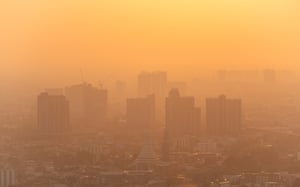
If you were on a Michigan job site last week, you didn't need a news alert to know something was wrong. The sky went hazy, the air smelled like a campfire, and by Thursday afternoon, Metro Detroit had some of the worst air quality of any major city in the world. Smoke from wildfires burning across Ontario and northern Minnesota settled over the entire state.
At CSM Group, safety isn't just about hard hats, harnesses, and fall protection. It's about recognizing new and evolving risks before they become incidents. Wildfire smoke is one of those risks, and this summer gave us a real-world stress test.
What Happened
Statewide air quality alerts went into effect across Michigan starting July 15, with the Michigan Department of Environment, Great Lakes, and Energy (EGLE) warning of conditions ranging from Unhealthy for Sensitive Groups to Hazardous in some areas. The Upper Peninsula saw ash fall. Visibility in parts of the state dropped to half a mile. And meteorologists tracking the event said the smoke's reach across the Great Lakes and the East Coast made it one of the most severe pollution events the region had recorded, surpassing even the widely remembered 2023 smoke event.
For outdoor construction crews, that combination of extreme heat and hazardous air quality arriving at the same time is exactly the kind of compounding hazard that can catch a jobsite off guard if there isn't already a plan in place.
Where We Stand Today
Our Safety Department is currently reviewing industry best practices and developing a formal air quality policy. In the meantime, our job sites are relying on the following guidance:
- AQI 151 — Exercise caution. Crews stay indoors as much as possible, and trade partners onsite are notified that the AQI is somewhat elevated. Employees may choose to leave if they feel their health could be adversely affected, or wear N95 dust masks; that choice is at their discretion. The Safety Department begins monitoring conditions closely.
- AQI 301 — Suspend outdoor work. This is the threshold at which the EPA considers air quality hazardous, where nobody should be outside unless necessary, and even then, exposure should be limited and respiratory protection should be worn.
- Notification process. As soon as the Safety Department is aware that AQI is reaching a level requiring action, the field is notified ASAP by text, followed up with an email.
Lessons Learned on Our Sites
-
Air quality has to be part of the daily huddle, not an afterthought. Just as we check the forecast for lightning or high winds, AQI should now be part of the routine morning safety briefing during wildfire season. A five-minute check of the AirNow or EGLE alert map can change the entire plan for the day.
-
Heat and smoke together change the math. A heat advisory alone might call for more water breaks. A smoke advisory alone might call for reduced exertion. When both hit at once, crews need clear, predefined thresholds for when work is modified, rescheduled, or paused, not a judgment call made in the moment by an already-stretched superintendent.
-
PPE conversations need to expand. N95 respirators aren't just for dust and silica anymore. Having them on hand and having crews actually trained on when and how to use them for smoke exposure needs to be standard stock for any outdoor job site during the summer months, not something scrambled for after the alert is already issued.
-
Consistency across sites matters more than ever. This is a theme that's come up in our own internal safety reviews this year: standards and preparedness can vary from project to project. A wildfire smoke event doesn't hit one job site; it hits every job site in the region at once. That's exactly the kind of moment where a standardized, site-specific safety plan pays off, because every superintendent should be making the same call, informed by the same data, at the same time.
-
Communication needs to be fast and direct. Our peers and trade partners have told us they want more real-time, verbal communication about safety, not an email that sits unread. Air quality events move fast. A plan that relies on someone checking their inbox isn't fast enough. Text alerts, radio calls, and in-person toolbox talks are what actually reach crews before conditions turn.
Building This Into How We Work
Wildfire smoke reaching Michigan from hundreds of miles away used to feel like an unusual event. It's increasingly a summer reality, which means it belongs in our standard safety planning alongside heat, weather, and traditional job-site hazards. We're taking the lessons from this event and folding them into our broader push for more consistent, proactive safety practices across every CSM Group project, because the goal isn't just passing an audit or winning an award. It's making sure every person on every site goes home safe, no matter what's in the air that day.