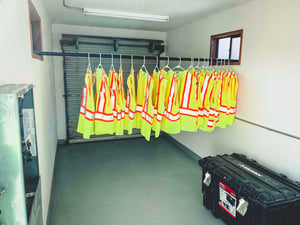
Walk any active job site, and you'll see the same gear everywhere: hard hats, harnesses, high-vis, gloves, steel-toe boots. It's easy to assume protective equipment is protective equipment; as long as everyone's wearing it, everyone's covered. For many women working in construction, that assumption doesn't hold up.
August 26 is Women's Equality Day, marking the 1920 certification of the 19th Amendment and the constitutional right to vote it secured for American women. The day has grown into a broader moment to look at where equality still falls short, including in places that don't always make the list, like the gear workers put on before they start the day.
Personal protective equipment exists for one reason: to keep the person wearing it safe. That only works if the equipment actually fits.
A gear gap built into the design
PPE sizing has historically been built around the proportions of an "average" male worker, a baseline that goes back decades in how gloves, harnesses, coveralls, respirators, and boots were engineered and tested. For a long time, "women's PPE" simply meant men's small, sometimes relabeled in a lighter color. That approach ignores real differences in torso length, hip-to-waist ratio, hand size, shoulder width, and foot shape, leaving a meaningful share of the workforce wearing gear never designed with their bodies in mind.
Women make up a growing share of the skilled trades and field workforce, and that trend is expected to continue as the industry works to close a well-documented labor shortage. As more women take on roles that require hard hats, harnesses, gloves, and steel-toed boots every day, the gap between the PPE that exists and the PPE that fits becomes a minor inconvenience. It becomes a safety liability that touches more of the industry every year.
This isn't a cosmetic issue; it's a safety one. Gloves that are too large reduce grip and dexterity and can get caught in machinery. Coveralls with excess fabric around the legs or sleeves create trip and entanglement hazards. Harnesses that don't sit correctly across the chest and hips can shift under load, undermining fall protection exactly when it matters most. Boots that don't match the foot shape affect balance and increase the risk of slip- and fatigue-related injuries over a long shift. And respirators that don't seal properly against a smaller or differently contoured face can fail a fit test outright or worse, pass with a loose seal that offers a false sense of protection.
There's a compliance dimension to this, too: PPE only protects people when they actually wear it correctly. Gear that's uncomfortable, restrictive, or visibly ill-fitting tends to get pushed aside, adjusted improperly, or worn inconsistently, which reopens exactly the exposure it was meant to close.
What the standards require
This isn't a new or optional idea from a regulatory standpoint. OSHA's construction PPE standard, 29 CFR 1926.95, requires employers to ensure PPE "is selected to ensure that it properly fits each affected employee." The general industry standard, 29 CFR 1910.132, sets the same expectation. Proper fit isn't a nice-to-have layered on top of safety compliance - it is safety compliance, and treating it as anything less is how compliance quietly becomes complacency.
The industry is catching up
The good news is that this gap is increasingly visible, and the market is responding. More manufacturers now offer size-inclusive and gender-specific lines built from different base patterns rather than simply scaling down men's designs: hard hats with adjusted shell shape and suspension, harnesses cut for hip and chest differences, glove lines that size for hand shape rather than just circumference, and boots built on a women's last rather than a shrunken men's one. Fit testing programs for respiratory protection are also getting more attention as a universal requirement, not an afterthought for anyone whose face doesn't match the "standard" test panel.
None of this happens automatically. It takes safety teams and site leaders actively asking for a broader range of sizes and cuts when selecting and stocking PPE. Change in this space has tended to follow demand: the more consistently purchasers ask for size-inclusive options, the faster manufacturers have moved to close the gap.
Where we stand
At CSM Group, we've long said that safety is more than a priority; it's a core value embedded in everything we do. That standard doesn't change based on who's wearing the gear. It's why we work to equip our own teams and hold our trade partners and suppliers to the same expectations, with PPE that actually fits the people using it, not just the "average" worker it was originally designed for.
Women's Equality Day traces back to a specific, hard-won milestone: decades of organizing by women who were told, in effect, that the systems around them weren't built with them in mind and would have to change. PPE fit is a much smaller problem by comparison, but the underlying pattern is familiar: equipment, standards, and systems built around a default that doesn't describe everyone who now depends on them.
Equality shows up in details as much as in headlines. On our sites, equal protection means exactly that: protection that fits, for everyone doing the work.
Learn more about how safety and well-being shape everything we do at CSM Group through our Total Human Health program.